|
|
 |
| |
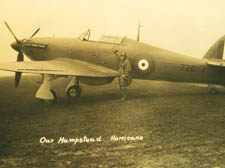 World War 2 Hurricane. Photos: Camden Local Studies and Archive Centre except where stated World War 2 Hurricane. Photos: Camden Local Studies and Archive Centre except where stated |
The day lives were changed forever
Seventy years on... In September 1939, the Prime Minister announced that Britain was at war, and life would never be the same for the men, women and children of north London
LIFE in London changed forever when war was declared in September 1939, and Camden, Islington and Westminster rapidly became part of a “total war” effort.
Men and women in their thousands enlisted in the Royal Navy, the Army, or Royal Air Force. Army recruits often went into one of the many infantry or cavalry regiments with local connections.
The Artists Rifles, based in Dukes Road, Bloomsbury, which later formed the basis of the SAS, became an Officer Training Corps that trained hundreds of men between 1939 and 1945; the Westminster Dragoons, part of the County of London Yeomanry, were to be the first armoured troops ashore on D-Day at Gold Beach, Normandy in 1944.
By October 1939, men aged between 18 and 41 who had not volunteered were eligible for conscription. By 1941, women could also be conscripted.
Thousands of local people were among the 440,000 British dead. Memorials in the three boroughs commemorate their sacrifice.
Those who did not fight saw their streets turned into a battleground, and their lives transformed – by the evacuation of children to the countryside, rationing, and worry about loved ones fighting in Europe or in the skies above England.
“A Pied Piper has been visiting Hampstead and he has taken away nearly all our children,” wrote the Hampstead News in September 1939. “This new piper has taken them to places of safety where they are happy, but we who are left miss their cheerfulness and smiles.”
Some evacuees were to spend years apart from their families.
The city’s landmarks assumed a martial aspect, tinged with make-do and mend spirit. Finsbury Park, Hampstead Heath and Regent’s Park became anti-aircraft posts; while other parkland was converted to vegetable plots.
Hundreds of men and women served in units such as the Holborn Civil Defence Service, whose dangerous work was to save victims of bombings and prepare for the mass poison gas attacks that were thought inevitable but which never came.
Bombs did come, however. Camden, Islington and Westminster residents had been among the first in the world to experience aerial war. German zeppelins bombed parts of Holborn, in 1915, during World War I. In 1918, 20 people were killed during an air raid on St Pancras, and in 1917 the German Gymnasium, which still stands in Pancras Road, was partially destroyed.
In Camden’s archives there is a record of an interview with Gospel Oak resident Albert Moody, who witnessed a First World War raid: “This was terrible – what an outrage, killing civilians like this, only soldiers get killed in wartime.” By the Second World War, such bombings had become routine. The Blitz – Luftwaffe airstrikes that began in 1940 – killed thousands across north London, including Camden’s three boroughs of St Pancras, Holborn and Hampstead.
St Pancras, with its rail termini and gas works, was heavily targeted. An estimated 957 people were killed by air raids, and both St Pancras and King’s Cross stations were badly damaged.
Holborn, though small, was hit hard. An official guide to Holborn, published in 1956, recorded the damage: “Mere figures cannot convey the terrors of the heaviest attacks, they cannot reproduce the scene when Theobalds Road was burning, and they cannot do justice to the courage and fortitude of the citizens of the borough.” In all, 426 people were killed.
Hampstead borough had no major military targets but still suffered. Broadhurst Gardens was hit by “flying bombs”, as early rockets were known, while West Hampstead’s railway lines were also attacked. A single parachute mine which fell on Fellows Road on the night of April 16, 1941, killed 24 people and destroyed six houses. In all, 204 people were killed by raids on Hampstead.
Londoners took cover from the bombs in shelters that sprang up – or down – across the three boroughs. Celebrated “deep-level” shelters were built at Belsize Park, Goodge Street and Camden Town Tube stations, but many spent their nights on the platforms of normal underground railway stations – served tea by volunteers until the all-clear sounded – or in purpose-built shelters such as the one built under Finsbury Town Hall in 1940.
War against Germany ended on May 8, 1945, and Japan surrendered in August 1945. Exhausted by nearly six years of conflict, people began the long process of reunion, reconciliation and reconstruction. The rebuilding of these boroughs was to take decades.
PAUL KEILTHY
|

|
|
| |
|
|
|


