|
|
 |
| |
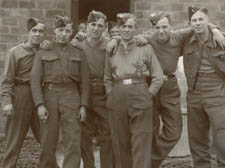 Peter Richards, Right, with Comrades at a West London barracks in 1943 Peter Richards, Right, with Comrades at a West London barracks in 1943 |
‘It was a war we had to fight. It was the right thing to do’
Some fought fascism in Europe, others fought the Blitz fires that ravaged London; some sheltered in the countryside, while others sought refuge in the capital’s Tube stations. Here, local people share their memories of the war. By Josie Hinton, Peter Gruner and Jamie Welham
‘You knew the danger but you just carried on’
Richards
Author and historian.
IT has been 70 years since the outbreak of the Second World War. But for author and historian Peter Richards, nothing that has happened since remains so firmly etched in his memory.
“I remember it more clearly than I remember what happened the other day,” says the 85-year-old, who has written about his experiences of the Second World War in his book, Bombs, Bullshit and Bullets – In Roughly That Order, published in 2007.
When war broke out, Peter was a 16-year-old “telegram boy messenger” based at Belsize Park post office, responsible for delivering telegrams across Camden on a motorbike.
He recalls: “The terrible thing about the job was delivering the news that husbands and sons had been killed. It was happening daily but you never got used to it.
“I remember visiting a mother in Dalby Street whose son had been drowned. She was in absolute hysterics.”
As the war intensified, Germany began its sustained campaign of bombing on London, which killed more than 20,000 civilians and destroyed more than a million houses by the end of May 1941.
Peter remembers the nightly mass migration of Camden’s residents to the borough’s underground platforms.
He said: “The government had initially said that Tube stations were not to be used as shelters, but people flocked down there anyway. We had an Anderson shelter but it was always flooded, so you had to decide between dying from bombs or from pneumonia.
“The Tube platforms had no toilet facilities and the smell was pretty grim. Every time you came off the Tube you had to step over hundreds of sleeping bodies.
“In the end the government relented and started bringing in bunk-beds and mobile toilets.”
Looking back, Peter recalls the courage with which people went about their daily lives despite the daily air raids.
“You knew the danger and you saw the human cost all around you, but at the same time you had to carry on living as best you could,” he said.
“People had to try and have a sense of humour. I remember a man coming outside and, being faced with a department store in Hampstead Road that had been totally destroyed by bombs, saying: ‘Looks like the mice have got in’.”
'Bradford was my home after the evacuation'
Valerie Shoebridge, 76
Foster parent and childminder
SHE was just six years old, but Valerie Shoebridge remembers standing on the train platform, gas mask in hand, waiting to be evacuated out of London to Yorkshire.
When she arrived in Bradford, the 76-year-old said she recalls feeling a connection to the northern county, where her grandfather lived.
“I was staying with a very nice family so I felt lucky,” she said. “My grandfather was from nearby in Barnsley so I was excited to be there. But my brother wasn’t so fortunate. He was in a really posh house where he had to behave himself impeccably. He had to take his shoes off at the door – he wasn’t used to that at all.”
After a year in Yorkshire, Valerie moved back to London.
She said she remembers weekly visits to her auntie and uncle in Redington Road, Hampstead.
She said: “I used to sit in the window of my bedroom and wait for the bus to come down the road, as it was safer than the bus stop. As soon as I could see it I’d run straight from the house and jump on.
“I remember one day in particular I could see several people waiting for the bus, when a buzz bomb came over and exploded. To this day I don’t know what happened to the people because at the moment the bus came down the road and I ran to get on it. No one else got on after me.”
‘What was left of the shelter? The bodies of dead children’
Florence Bunting, 99,
Retired cook
Florence Bunting, 99, was working for St Pancras Borough Council when the war broke out, and was widely renowned among the staff for her bread and butter puddings.
Florence recalls: “When I got the job they said I was to be in charge of sweets. They told me I had to make a bread and butter pudding with dried egg powder instead of eggs. I told them that was impossible, but I proved myself wrong when I did it. My puddings were so good no one could taste the difference.”
Florence was living in Alma Street, Kentish Town, with her husband Bernard Drey, who served in the Royal Army Ordnance Corps.
As he was stationed away from home, supplying and maintaining weapons for the army, she spent her evenings sleeping in Kentish Town Tube station.
The Blitz began with the bombing of London for 57 consecutive nights. But despite the daily raids, Mrs Bunting said there is one particular day that sticks in her memory.
“I was walking along Grafton Road when the alarm sounded that day,” she said. “Everyone was running for cover and looking for a safe place to hide. There was a small brick shelter, too small for adults, but big enough for children to squeeze inside.
“All the mothers and fathers were putting their children there, telling them: ‘You’ll be safe in here.’ There must have been about 40 or 50 children inside when a bomb came over and landed on the shelter.
“All that was left was rubble and dead bodies – utter devastation.”
Islington
‘I lost a lot of friends on the fields of Europe’
George Durack
Retired plumber
Retired plumber George Durack, 85, remembers a shoot-out with the Germans in Caen in France with good friends and colleagues dying on either side of him.
Born and brought up at Whitecross Street at the Angel, George volunteered for the rifle brigade when he wasn’t yet 18.
His unit trained in Yorkshire for six months and were taught, among other things, how to drive a vehicle, but most of all how to use a rifle and become efficient killing machines.
He went on to join C Company after it had almost been wiped out on the way to Germany. He said: “At first I had no perspective of what was going on. I felt no fear. It was two years into the war when I suddenly realised I might get killed.
“That’s when I witnessed people on either side of me being shot, injured and killed. I’d seen men beside me blown away. I lost a lot of good friends and comrades. I realised I’d been very lucky.” George started out as private and ended the war as an acting lance corporal for his section because of the number of men that were lost.
He remembers one bizarre experience in a Belgian town taken by the British when he and two comrades were looking for somewhere solid to shelter during a bombardment.
“We found this café,” he said, “and the three of us bedded down behind what we thought was a good, solid wood counter.
“When we woke up in the morning we found the counter was actually just a piece of brown paper. But we’d felt totally safe and slept like babies because in our minds it seemed like a solid object.”
George married in 1953 and has a daughter who is now 54. He was a Labour councillor in Islington from 1990-94, and is now Chairman of the Islington Pensioners’ Forum.
He added: “You still get flashbacks and remember people we lost. I’ve always thought how horrible wars are and until now I’d never really wanted to talk about it.”
‘It seemed that civilians suffered the worst of it’
Jean Jeapes
Retired store worker
It’s a cold damp night in October 1940 and teenager Jean Johnson, her family, and soon-to-be-husband, Les Jeapes, are all huddled together in a makeshift bomb shelter in the garden of their home in Grosvenor Avenue, Canonbury.
It has been a relatively quiet night and everyone is waiting for the all clear siren to allow them to emerge from their concrete bunker.
Jean, now 84, takes up the story: “Suddenly there is a rushing sound and it is getting louder and louder. Then there’s a terrific and deafening explosion. My Dad called out: ‘Don’t move anyone. Stay calm.’ I was petrified. Dad finally climbed out of the bunker to find out what had happened.”
Not only was their house completely demolished by what turned out to be a 500lb bomb, but tragically the family next door were killed. They had also been sheltering in their own garden concrete dug-out.
Jean added: “It was a terrible incident. They were good neighbours. But it could have happened to anyone and life had to go on.”
Jean’s family were given emergency accommodation in a reception centre at Canonbury School for a few weeks before they found a new place to live.
She added: “The Germans seemed to miss their targets, whether deliberately or intentionally. The result was that civilians appeared to suffer the most.”
‘Entire buildings were levelled by the nightly raids’
Harry Walters,
Historian
Harry Walters wrote about growing up in the Blitz in his autobiography, Bricks and Mortar, published by Islington Archaeology and History Society.
Harry can still remember the smells from those damp and musty nights; soot, creosote from the bunks, candles, and the acrid and ever prevalent waft of smoke from bombed out buildings.
A flying bomb fell on a bright sunny morning in June 1944 in Queensbury Street. “When we went round to see the damage we could hardly believe our eyes. The area of devastation was vast, large buildings had completely disappeared and the inside of shops in Essex Road could be seen.”
Describing one of the worst incidents of the war, the bombing of Highbury Corner, he wrote: “I was running around the playground in Popham Road School, with some kids who had not been evacuated, when the whole place shook. There were 24 deaths and 116 casualties.”
The following year 11 rockets fell on Islington. “These gave no warning whatsoever, and all people could do was go about their business and hope for the best. “
Westminster
‘I was a POW for three ghastly years in Changi’
Frank Rogers,
Retired businessman
Frank Rogers doesn’t talk about the war. Remarkably the 90-year-old hasn’t spoken to anyone about the horrors he experienced as a Japanese prisoner of war until now.
“It was a part of my life I want to forget. It was a ghastly thing,” says Frank, who was a fresh-faced newlywed, just 19 years old, when he was captured and taken to Singapore’s notorious Changi Prison.
The private in the Royal Artillery didn’t even get a chance to fire the canon for which he was trained.
Like so many at the time, Frank’s story started very differently. He left his job at the gramophone store where he worked in Shaftesbury Avenue to join up full of the youthful exuberance which is now such a cliché to talk of when evoking the mood at the start of the war.
“It wasn’t for the cause or patriotism or anything like that,” he recalls.
“My friends were going and I wanted to be part of the gang.”
Most of them never returned.
Frank speaks of his three years as a POW with scant emotion.
“We had no hope but we just got on with it. We had no other choice. None of us knew if we were going to see our families again. I was just lucky not to be sent to the railway.”
Frank was beaten regularly and remembers having to survive on scraps of rotten food. He narrowly escaped death when the vehicle he had helped his Japanese captors repair crashed head on with another vehicle. The scars remain.
The Japanese surrendered the island in August 1945, and Frank returned to his wife and home in the Peabody Estate in Covent Garden, where he lived until just two years ago before moving to his current home at the Westmead Care Home in Westbourne Park.
The word hero means nothing to Frank. “A lot of people try and glorify the war but the truth is nobody knew what they were doing.
“Most talk of heroes and brave people is all hot air. It was cruel and futile.”
‘The restaurants closed down as the Italian staff were interned’
Elena Salvoni
Restaurateur
Powdered eggs and rabbit. That’s what Elena Salvoni served up to the legions of hungry
servicemen on leave who flooded Soho during the war – a world away from the indulgent fare the now 89-year old maître d’ presides over in her eponymous Charlotte Street eaterie, Elena’s L’Etoile. Elena remembers her days as a young waitress at Café Bleu in Old Compton Street fondly.
“When the bombs were coming down, we had to black out the windows and get on with it,” she recalls.
“I remember many times having to turf everyone out mid way through their meals. We just charged them for what they ate and rushed them to the shelters and Leicester Square Tube. The food was left on the tables.”
The then 18-year-old, born to Italian immigrants, remembers having to conceal her identity when Soho’s sizeable Italian population came under heavy persecution once Mussolini joined the war.
“It was alright for me. Occasionally we got called names, but because I was born here and had a London accent I was spared internment.
“The area lost so many of its Italian restaurants because all the waiters and managers were all put in prison.”
She recalls her joie de vivre at a time when uncertainty permeated every waking hour, telling of how she and her fellow waitresses would run down to the Royal Opera House for tea dances between shifts.
Elena, whose daughter was born during the bombings, narrowly escaped death when the Islington townhouse where she still lives to this day missed a direct hit by millimetres.
“We woke up at 4am and the upstairs bedroom was on fire. I remember running up and down the stairs with buckets of water to put it out.
“Our next door neighbours’ house [later home to the infamous playwright Joe Orton] was completely destroyed.”
‘A lot of firemen lost their lives. I was working with brave men’
Stan Brown
Journalist
When London was burning in 1940 it was the firemen, not the military, who formed the front line.
Stan Brown joined the Auxiliary Fire Service the day war broke out – September 1, 1939. He was 17.
Now aged 86, the career journalist lives in Lisson Grove, less than a mile away from his old base at Essendine Primary School in Maida Vale.
He remembers tearing around the capital on his motorbike, alerting officers to incendiary bombs, calling for backup
and being part of what was the first line
of defence against the Luftwaffe.
“It was an important job and it was the making of me. I remember us all living in the school like a big family. There were a lot of old navy boys and a lot of conscientious objectors. It was very strict and I really felt part of something. I was among brave men.”
Stan recalls one fateful evening when one of his colleagues, an ardent “conchie” who joined the service so he wouldn’t have to go to war, died trying to tackle an explosion at St Catherine’s Dock.
“It’s always stuck with me,” he recalls. “It wasn’t unusual either. A lot of firemen lost their lives during the Blitz.
“But I do think fighting the war was a necessary thing. It was the right thing to do.”
|

|
|
| |
|
|
|


