|
|
 |
| |
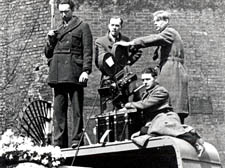 Humphrey Jennings at work with his crew Humphrey Jennings at work with his crew |
A hero in the battle for hearts and minds
As war raged across Europe,
film-makers like Humphrey Jennings were taking the fight against fascism
to the silver screen, writes Dan Carrier
WHILE pilots battled to keep the skies free of the Luftwaffe, the navy protected food convoys in the Atlantic and Dunkirk survivors were re-arming, the battle was raging on a less likely front: the silver screen.
As the war started, the government began to realise that the popularity of the “pictures” could be harnessed to help beat fascism – and made an unlikely war hero of a Camden Town film-maker.
Humphrey Jennings had cut his teeth working for the General Post Office (GPO), which had been put in charge of making films by the government during the 1930s.
Jennings has not become a household name – his life was tragically cut short in 1950, when he fell from a cliff in Greece while scouting for locations. But his influence on film-makers cannot be underestimated – nor the role he played in helping to win the war.
From a left-wing background, he had an interest in chronicling the lives of working people and was involved in establishing in the mid-1930s the Mass Observation Unit, which had partly been a product of the Depression. Social scientists wanted raw data to find out how those in poverty lived, and the unit was supposed to provide such information.
It gave him the experience he needed, so that when asked to make short films about the impact of the war on the daily lives of people, he could approach it in a way that had never been done before. Previously those appearing on celluloid spoke with BBC accents, but Jennings turned his camera lens on those who had never had their voices heard before, and by doing so explained how the war was affecting everyone, and in turn why it was so important the war was won. He set out to make films that mirrored the aims of Mass Observation: he wanted to portray on film the routines of the working masses, their lives away from the factory gates.
Jennings was born in Walberswick, Suffolk, in 1907, the son of an architect and painter. He went to Pembroke College at Cambridge and took a lively interest in drama which it set him on the road to his later film work.
It was in 1934, when the British film industry was beginning to sprout real buds, that Jennings joined the government’s General Post Office film unit.
But it was with the outbreak of war that Jennings’s work really came to the fore. As Britain stood alone against the rolling armies of Nazi Germany, the GPO unit was turned into the Crown Film Unit, and put under the auspices of the Ministry of Information.
“At the start of the war, nobody really knew what to do in terms of film-making,” says Birkbeck College’s Professor Ian Christie, who is an expert in film and media history. Could the cinema be in someway harnessed to help? Nazi Germany already had a strong tradition of propaganda movies, extolling the Aryan dream. Could British film-makers paint a realistic picture of why the war had to be fought? Jennings answered decisively through his work.
“People assumed at first that the government would order all cinemas to be closed, ” Professor Christie explains. This was partly down to fears over public safety – no one quite knew how terrible the bombings would be, and having 500 people crammed into a dark auditorium as high explosives reigned down from the skies obviously caused genuine worries. “But they quickly realised this was an absurd idea.”
The change in policy was to be crucial in terms of keeping up morale during the war.
And at the same time, as well as offering escapism, the Crown Film Unit turned their attentions to the documentary genre.
“The documentary had three roles to play and the government paid for hundreds of short information films to be made,” says Professor Christie. “They were there to give out vital information. They covered issues such as what to do about food shortages – information about how to grow your own food – and what to do in the event of a gas attack.”
Others films offered advice as to how to spot “fifth columnists” and carried warnings about “keeping mum”, the cinematic version of the famous poster that carried the slogan: “Walls Have Ears.”
The second aim of the unit was to build up morale – something that Jennings, with his unerring eye for studying the lives of “everyday” people, did brilliantly.
“He was charged with helping to keep people feeling good about the war,” says Professor Christie.
But his propaganda films were also aimed at a totally different audience – foreign cinema audiences, in particular those in America, to try and persuade them to help.
The film Listen To Britain was a particular masterpiece. It wove together images of Britain at work, spliced together with a soundtrack that amplified the noise of the factories, of the pit, the harvest.
“It was solely intended for foreign consumption, and a way of saying these are the sounds of Britain at war,” says Professor Christie. “It is an amazing film – a tapestry of everyday life in Britain.”
Jennings went on to make Fires Were Started, which told the story of the immense bravery of volunteer firefighters working alongside professional units as they battled Blitz blazes in London. Later, he made A Diary for Timothy, which told of the first six war-torn months of a baby’s life, and was meant to instil a sense of what the soldiers were fighting for, by pondering what the future held for the child.
But as well as the less-glamorous movies showing miners hacking away at the coal faces or East Enders staving off the nightly fears of bombing raids as they slept on Tube platforms, fictional films had a role to play, too.
In Hollywood, Casablanca aimed to show that being an anti-fascist was a heroic pastime: it was hoped Humphrey Bogart’s character, who had run guns to Ethiopians and fought in the Spanish Civil War, would help rally public opinion.
The Ministry of Information worked with commercial film companies to encourage them to make propaganda films.
“A good example of this is the 49th Parallel,” says Professor Christie.
The 49th Parallel told the story of a six-strong U-Boat crew stranded in Canada and trying to make their way to the then-neutral United States.
“It was given seed funding by the Ministry of Information to get it started and was a clear and deliberate attempt to explain why America should join the war.”
Another effort was made by director Alexander Korda, who gave us Lady Hamilton, starring Laurence Olivier and Vivien Leigh. It told the story of Horatio Nelson and his lover, Lady Hamilton. Made in Hollywood, again with government backing, it was
full of stirring speeches and vignettes about Britain standing alone against tyranny on the content.
“It got Korda into real hot water,” says Professor Christie. “He was accused of warmongering, but the case was quietly dropped because, while he was being investigated, the Japanese bombed Pearl Harbour.”
Other films were extremely popular and just as unsubtle: the Noel Coward / David Lean vehicle In Which We Serve put a gang of disparate crew in a life boat, drifting through the Atlantic: the survivors were seen as examples of how the nation was in it together, no matter what your background was.
“It was a question of showing how different ranks all pulled together,” says Professor Christie.
“They were all ready to face adversity together – like the nation.”
•
|

|
|
| |
|
|
|


