|
|
 |
| |
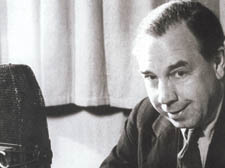 JB Priestley on the radio JB Priestley on the radio |
Priestley looked to the prize of a much more just society
JB Priestley’s radio series spoke to the nation of socialist post-war aims in the voice of the common man – much to the alarm of many Conservatives. By Dan Carrier
THE ghosts of fallen comrades haunted JB Priestley as he sat down to enjoy a reunion meal with his old regiment, 15 years after the guns had fallen silent on November 11, 1918.
But it was not just thinking of those absent friends who had laid down their lives for their country that made the author morose: he was haunted by those who had survived, but could not afford to attend the party. It was not just the bill for the meal that made it beyond their reach – it was the shame of not having a wearable suit to turn up in.
Priestley recounted this moving episode in his seminal 1934 book English Journey – and the experience, which moved him deeply, sowed the seeds for a series of stunning broadcasts he made during 1940 and 1941 on BBC radio that became a key feature of life in Britain during the war.
Priestley, who had become a household name for novels such as The Good Companions, his plays and journalism, was approached during that crucial summer by the Ministry of Information and the BBC with the idea that he pen a few talks to help raise morale.
They were scheduled for a prime time spot: just after the nine o’clock news on a Sunday night, when the nation was tuned in.
As bombs rained down on London, Priestley left his home in Highgate and made his way to Broadcasting House in Portland Place. He was given a room in the Langham Hotel opposite and he narrowly avoided being a victim of the Blitz himself when a bomb demolished the hotel, reducing the room he was staying in to rubble.
His “fireside chats” could be on any topic of his choosing. In the first series he rallied people, reminding them of what they were fighting for. He was also asked to speak on the World Service in the middle of the night, to bolster support for Britain’s cause in the USA and other English-speaking countries.
His talks, called Post Script, became an instant hit. First broadcast on June 5, 1940, it caught the wave of emotion felt by those who had watched with horror the debacle at Dunkirk.
Dr John Baxendale, who teaches social and cultural history at Sheffield University, believes Priestley’s taking to the airwaves came at just the right time.
“It was a special moment in our history,” he states. “It was when social divisions disappeared and people were united in a common cause. He started doing them at the crucial moment when the phoney war [the period from September 1939 after the German invasion of Poland to April 1940 when there was little military activity] had ended and the Germans were moving westward.
“His first broadcast about Dunkirk was a wonderful piece of writing, and of speech. It was the start of the beginning of the myth of Dunkirk [turning what was a defeat, when the British army had to withdraw, into a heroic victory].”
JB’s son Tom recalls how his father had a knack of finding an angle that people could relate to: with his Dunkirk broadcast, it was his focus on the role the little ships had played.
“He spoke of a paddle steamer called Gracie Fields that he had known well,” Tom recalls. “It used to take people from Lymington to the Isle of Wight, where my father had a home.”
Churchill spoke in the House of Commons about Dunkirk and then repeated his speeches on the radio: but while Churchill’s orations have gone down in history for their lyrical brilliance and their impact, Priestley at the time had the much greater popular appeal.
“They represented two sides of the British character,” says Dr Baxendale.
“Churchill represented the aristocracy, with an oratory that used high blown language, while Priestley spoke in a northern accent, an ordinary voice talking about commonplace things, and it was very endearing to those who tuned in.
“They showed the opposite ends of British culture, although both appealed in different ways.”
But it was the author’s own war experiences in the First World War and what had happened at a reunion dinner that meant his talks, after the immediate threat of invasion had passed, took a more controversial angle and led Tory backbenchers to attack him for their content: he had begun to speak about what sort of Britain would emerge when the war was won.
“It was a very murky business,” says Dr Baxendale.
“We do not know exactly what happened, but the BBC’s archives have shown that there was a lot of pressure put on the BBC by Tories to take him off the air, or rein him in. He was regarded as an official spokesman – an official spokesman who wanted to discuss what sort of Britain would emerge after the war.
“He was advocating socialism. He was telling people: You are not fighting to preserve the old ruling classes – you are fighting to make the world a better place for every one. It is hard to say whether the government intervened – the establishment worked by nudges and winks and [it] was a world where chaps in clubs would get these things done.”
Tom Priestley believes his father could not help but draw on his generation’s post-war experience, and was desperate to let the troops and their families know they would be treated in a better way.
“Earlier in the war it was about rallying people,” he says. “Things were pretty desperate and he had to remind people of their humanity, that despite all of the awfulness that was going on, we are still human beings.
“He looked upon this as his own personal contribution to winning the war.”
|

|
|
| |
|
|
|


