|
|
 |
| |
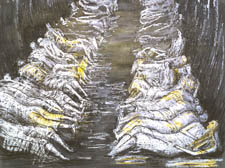 Pictured: Henry Moore’s Tube Shelter Perspective, 1941, Tate. Pictured: Henry Moore’s Tube Shelter Perspective, 1941, Tate.
Reproduced by permission of The Henry Moore Foundation. |
Caught in the Tube as the bombs fell
Artists were enlisted to
capture life as it was lived both in the
theatre of war and back in Civvy Street, writes John Evans
Artistic effort did not end with the outbreak of war. The age-old dilemma – whether any images of war can but glorify it in some way – resurfaced and the authorities, who recognised the importance of controlling such imagery, again commissioned war artists as they had done in 1916.
The War Artists Advisory Committee was instigated and over 300 became involved, including, Graham Sutherland and Stanley Spencer on the home front and Edward Bawden and Edward Ardizzone overseas.
A chance encounter for one, whose art studies had benefited from an ex-serviceman’s grant, would give birth to perhaps the most enduring series of wartime pictures, featuring the plight of civilians sheltering from bombs.
Henry Moore sketched a family he had seen in Belsize Park station one September night as he returned to his Hampstead home. From that moment, 70 years ago, the artist was to haunt the Underground, create his artworks of the shelters and inspire a number of other artists to follow in his footsteps. Although the Blitz forced his relocation to Hertfordshire, the WAAC purchased 28 of Moore’s drawings and distributed them across the country. He, too, was signed up as an official war artist.
Others to go underground included Edmond Kapp, who drew a girl comforting her younger brother on a station platform. Royal Academician Henry Carr painted his Familiar Silhouettes, showing soldiers chatting in front of an illuminated tube sign.
People sheltering in Belsize Park was also the subject of a John Farleigh ink wash sketch highlighting the difficult conditions there. Felix Topolski went down Leicester Square and also produced An Amateur Concert in Camden Town Rest Centre in October 1940.
Art was also used as a morale booster for the workers.
Slade-trained artist Olga Lehmann, later feted for her film and television costume and set designs, produced some war works, and these include A Shelter in Camden Town under a brewery, Christmas Eve, 1940.
Major galleries and institutions made evacuation plans. The Tate quickly moved out 250 artworks, many stripped from special air raid frames. Muncaster Castle and other secret locations outside the capital were used. The National went for storage of treasures among the slates of north Wales and the Parthenon Frieze spent part of the war down the tube at Aldwych.
An Imperial War Museum exhibition, Outbreak 1939, explores the build-up to and preparations for war and the early months of the conflict. It runs until September next year. Visit www.iwm.org.uk for details.
•
|

|
|
| |
|
|
|


