|
|
 |
| |
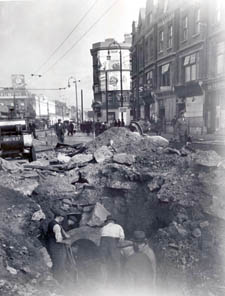 a Bomb attack in Pimlico and in Tottenham Court Road a Bomb attack in Pimlico and in Tottenham Court Road |
Facing the flames: the heroes with grimy faces
THE fire brigade was like any other service pre-World War Two: limited and without women.
After 1939, that all changed. Swelling from 2,500 members to nearly 30,000 countrywide, the Auxilliary Fire Service (AFS) formed in January 1938 in anticipation of the war.
Women and those who were too young, too old or too infirm to serve in the army, were signed up, and while work was slow-going at first – the AFS were initially nicknamed “Army Dodgers” – everything changed overnight on September 7, 1940.
On the first night of the Blitz, and for 56 nights thereafter, bombs pelted London and beyond. It was an onslaught that would leave 60,000 dead by the end of the war. A further 90,000 were seriously injured, and two million homes were destroyed.
Firefighters – many of whom received their training at the start of the war – were now know as a the “heroes with the grimy faces” in recognition of the brave and dangerous work they were sent out to do, night after night.
Despite blackouts, parts of Camden, Islington and Westminster were battered during the war years; among the buildings worst hit were the old Arsenal stadium in Highbury, Westminster Abbey, Euston Station and the British Library in Bloomsbury.
Under the emergency plans drawn up by the services, small fires were dealt with by civilian street fire attendants, who had been given limited training and little equipment.
While many women couldn’t drive before the war, they were taught in their thousands and went on to drive the fire vans and work in the mobile canteens – serving food where and when it was needed – as well as taking more traditional roles such as keeping the fire brigades’ communication networks up and running.
The mass of street fire alarms set up across the boroughs at the launch of the Blitz were dismantled soon after the war and replaced with the 999 emergency control room we’re familiar with today.
Speaking to the Camden History Society for a Camden Local History Library exhibition in 1981, former auxiliary fireman Albert Moody described how a “moment of reverie” was ended by a “piercing swishing” as bombs fell from the sky.
He said the swift action of neighbours averted greater destruction to Prince of Wales Road in Kentish Town one night, as “all [were] intent upon dousing these new destructive weapons of war.
“What a frightening experience this was. Despite the training most of us had, you don’t realise you are afraid until afterwards, [and] that’s a good job too, isn’t it,” he added.
Having been a builder, Mr Moody was taken off firefighting duties to lend a hand to the rebuilding effort, but was soon caught up in more bombings.
“It was because of this that I was in the darkened Harmood Street when all those fire bombs hit. What a good job I had had fireman training,” he said.
CHARLOTTE CHAMBERS
|

|
|
| |
|
|
|


