|
|
 |
| |
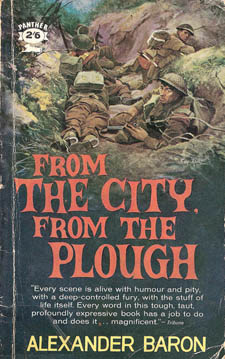 Alexander Baron's From The City From The Plough Alexander Baron's From The City From The Plough
|
A wartime novel drawn from the rank and file
Books about the war had been written by intellectuals. Alexander Baron decided that his would reflect the experience of the ordinary Tommy, writes Dan Carrier
AS Alexander Baron’s landing craft touched the French soil, it struck a mine. It was early in the morning on D-Day. Two of his comrades standing next to him died instantly – he was catapulted into the air and landed in the sea.
The writer says his lance corporal told him after things had got a little less hectic that he dusted himself off, charged to the front and shouted: “Take the rear rank, I’m not f*****g dead yet.”
Baron was a sapper in the Royal Engineers and helped lead the charge on that fateful June day in 1944 when the Allies landed in northern France and started the slow push to liberate Europe from the iron grip of Nazi Germany.
Baron did not get to follow his unit all the way across the Rhine. He had been knocked around a lot – apart from the incident as he landed on mainland Europe, his job as a sapper meant he was often at the very front of the action, clearing mines, laying down tracks for armoured vehicles, and making sure the main push of the Allied forces was not held up by natural and man-made obstacles.
His ears were constantly ringing from the explosions, and the stress of knowing that his work defusing mines and clearing the way was vital to the safety of the troops following him.
His commanding officer noticed after weeks at the front that the toll was beginning to tell, and suggested he be posted temporarily to Ireland to help train men in the use of small arms, an area he was an expert in.
While in Ireland, he was injured in a near-fatal truck accident. He was in hospital for six months with a serious head injury, a fact that meant he missed being posted back to France and missed the last push into Germany.
And it was because of this accident, according to Alexander’s son Nicholas, that, unlike so many of his comrades, he survived – and went on to write perhaps the greatest novel by a soldier who served in the Second World War.
From The City, From The Plough was Baron’s first book. Before the war he had worked as a journalist, penning pieces for the Labour League of Youth and working at Tribune – an entry into the left-wing movement of the time. He had even tried to get to Spain as a volunteer in the Civil War but was told by the Communist Party he would be better use in Britain campaigning for the cause.
He was not a Communist. Alexander was perturbed by the British party’s stance of backing the USSR to the hilt, even when it came to the non-aggression pact that Hitler and Stalin used to carve up eastern Europe. It meant while friends were calling the struggle against fascism as a capitalists’ war, Alexander marched to a recruiting office the day after war broke out and volunteered.
Alexander had in his youth been fascinated by the giant strides made in aviation. Like so many of his generation he had seen the RAF pilots lionised in the Great War, and then seen the massive leaps made in aeronautical technology. He tried to enlist in the RAF, but his eyesight was so poor they turned him down.
However, this was not going to stop his efforts to contribute to the war effort – he instead he joined the infantry and became a sapper.
Russia had signed a non-aggression pact with the Nazis. While his friends in the Communist Party followed the party line by not enlisting, Baron made up his mind to join the army as quickly as possible – and the result was a book that after the war was accepted as perhaps the most genuine account of what the experience of enlisted men was like.
“It was six years without books but full of experience,” he is quoted as saying in the introduction to his recently re-published novel King Dido. In it he explains how From the City, From The Plough came about.
“I was in the army until spring 1946,” he writes. “All the time, through those years, I was seeking experience. And knowing exactly what I wanted to do – I wanted to write a novel about the war. When I came out of the army, I was interviewed by a committee. They said ‘What do you want to do? And how can we help you?’ I said ‘I want a typewriter’. There was a 12-month waiting list, yet they got me a portable typewriter straight away and I just went home.”
And his efforts filled a huge gap in the post-war book market.
“After the war, the first novels to get published were all by officers,” he recalled.
“They were stories by intellectuals to whom the army was agony. They wrote about it as an awful experience, sleeping with 35 ruffians. The officers did not seem to have the Robert Graves touch. Graves, Sassoon, knew the Tommies were the men getting the rough end of the stick. I read those books and I thought that nobody was writing about the ordinary soldiers. Soldiers were the nation in arms, they were the whole people.”
It is hard to estimate the effect the book had. It sold a million copies just months after being printed, a colossal figure for the period.
It showed how people from all walks of life and from length and breadth of the country all came together in the nation's hour of need to complete an unimaginably horrendous job – a fact worth remembering on November 11.
|

|
|
| |
|
|
|


